

If you want exterior vinyl signs to survive the brutal Florida climate, you must use premium cast vinyl layered with a UV-protective over-laminate and rely on professional post-heat installation. Anything less will fade, crack, or peel within a single summer. Florida’s intense ultraviolet radiation and rapid thermal cycling destroy low-grade commercial signage in record time.
For local business owners in Ocala and Marion County, your outdoor displays act as your tireless 24/7 brand ambassador. When outdoor branding fails prematurely, it subtly damages market perception. This guide breaks down the material science of sun-proof graphics, helping you choose the right materials to ensure your storefront graphics outlast the elements and maximize your long-term ROI.
Material Matters: Cast vinyl is mandatory for high-heat environments; avoid calendered vinyl for long-term outdoor use.
UV Radiation is the Enemy: Florida’s 11+ UV index causes rapid photodegradation without specialized laminates.
Thermal Cycling Kills DIY Jobs: Extreme temperature drops from summer rainstorms cause cheap adhesives to fail.
Installation is Science: Professional post-heating resets the vinyl’s structural memory so it won’t shrink.
Understand the Climate Threat to Outdoor Signage
The Molecular Breakdown of Signage in Florida
Selecting the Best Material: Cast vs. Calendered
Avoid the Costly Pitfalls of DIY Sign Making
Why Professional Installation Guarantees Longevity
Maintenance Strategies to Extend Sign Lifespan
Align Your Signage with Fleet and Apparel
Frequently Asked Questions
Quick Answer: Florida’s combination of 90%+ humidity, daily thermal shock, and extreme UV rays creates one of the harshest environments for outdoor advertising in North America.
Exterior vinyl signs serve as the bedrock of your local physical marketing presence. Across North Central Florida, from the bustling commercial lanes of Ocala to the surrounding agricultural estates, storefront displays face a brutal environmental test.
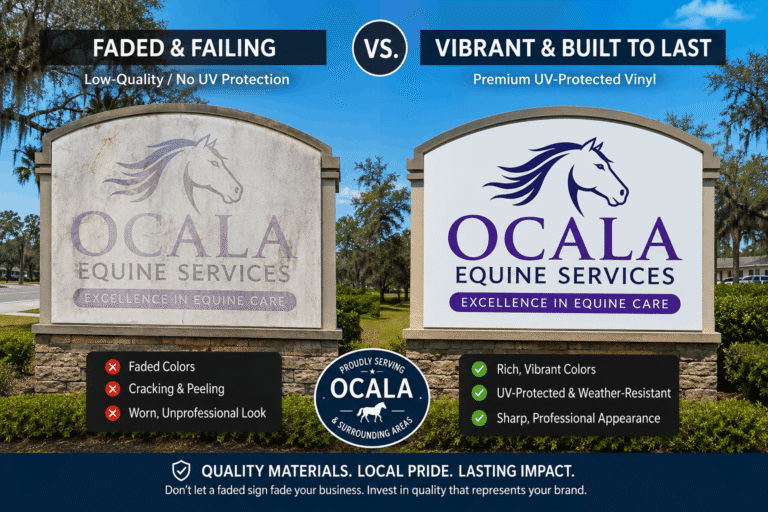
When passing foot traffic or potential commercial clients observe a faded, warped, or peeling display, they subconsciously register a lack of operational oversight. A crisp, perfectly aligned presentation communicates deep-seated structural stability.
Investing in corporate assets requires calculating long-term return on investment (ROI). Your outdoor banners, directional boards, and architectural displays represent the very first physical contact a consumer has with your brand. Replacing cheap signs annually costs significantly more than investing in premium materials on day one.
Quick Answer: Raw solar energy causes photodegradation in unprotected signs, breaking down the PVC molecular strands and bleaching the color pigments.
To build outdoor assets that survive, you must understand how the climate acts as a destructive force. According to the EPA, the Sunshine State routinely sees UV index ratings of 11+ from June through September. UV radiation acts as a molecular abrasive on exterior vinyl signs.
📊 Data Point: Dark sign surfaces under direct Florida mid-afternoon sunlight can easily reach surface temperatures exceeding 140°F.
Beyond chemical bleaching, sudden afternoon thunderstorms create severe thermal cycling. When a summer downpour drops that 140°F surface temperature by 40 degrees in just a few minutes, the materials rapidly contract.
Without advanced structural elasticity, this expansion and contraction destroys the adhesive layer. Cheap films cannot handle this movement, leading to edge curling, stress fractures, and moisture intrusion.
Quick Answer: Cast vinyl is an ultra-thin, highly durable film with no structural memory, making it ideal for Florida heat. Calendered vinyl is a thicker, economy-grade film that naturally shrinks and cracks in the sun.
When sourcing premium exterior vinyl signs, you will choose between two manufacturing types: cast and calendered. This choice dictates whether your display lasts a decade or fails in six months.
| Material Characteristic | Cast Vinyl Film (Premium Standard) | Calendered Vinyl Film (Economy Grade) |
| Manufacturing Base | Liquid PVC baked on casting sheets | Molten PVC forced through heavy rollers |
| Material Thickness | Extremely thin and flexible (~2 mils) | Thicker and more rigid (~3.4 mils) |
| Structural Memory | Zero structural memory (won’t shrink) | Strong internal memory (pulls inward) |
| Expected Lifespan | 7 to 10+ Years in high-UV regions | 2 to 5 Years (degrades in heat) |
| Best Used For | High-end outdoor signs, vehicle wraps | Short-term indoor promos, event banners |
Cast vinyl starts as a liquid poured onto high-precision casting sheets. Because it is never mechanically stretched, it has no internal structural memory. When exposed to Florida heat, it remains completely stable. It will not shrink or pull away from complex architectural surfaces.
Calendered vinyl is compressed through heavy rollers. This leaves it with an inherent structural memory; it constantly tries to pull back to its original shape. In the sun, it shrinks, leaving a sticky border of exposed adhesive that gathers road grime.
💡 Expert Insight: “Using the highest-grade cast vinyl won’t prevent failure if the installation environment is contaminated or if the material’s internal memory isn’t properly reset via post-heating calibration”.
Quick Answer: DIY sign making often utilizes low-grade online materials and improper surface preparation, resulting in bubbling, silvering, and rapid adhesive failure.
The availability of desktop plotters has led many business owners to attempt building their own outdoor marketing displays. While DIY works for temporary internal organization labels, trying to fabricate exterior vinyl signs usually leads to wasted budget and a less-than-professional brand look.
⚠️ Common Mistake: Using standard household glass cleaners to prep a surface. These leave behind invisible silicone residues that prevent commercial adhesives from bonding, causing signs to peel within weeks.
High-performance films rely on pressure-sensitive adhesives (PSA). Certain substrates, like freshly painted acrylics, release microscopic gas pockets over time. Without professional testing for surface energy and outgassing, DIY signs frequently bubble and fail.
Quick Answer: Professional installers use dust-free clean rooms, pneumatic laminators, and digital heat tools to ensure perfect adhesion and prevent edge lifting.
Building durable commercial signage requires industrial-grade tools. Professional sign shops use heavy-duty pneumatic laminators that apply perfectly even mechanical pressure. This removes the microscopic air pockets that cause DIY hand applications to fail.
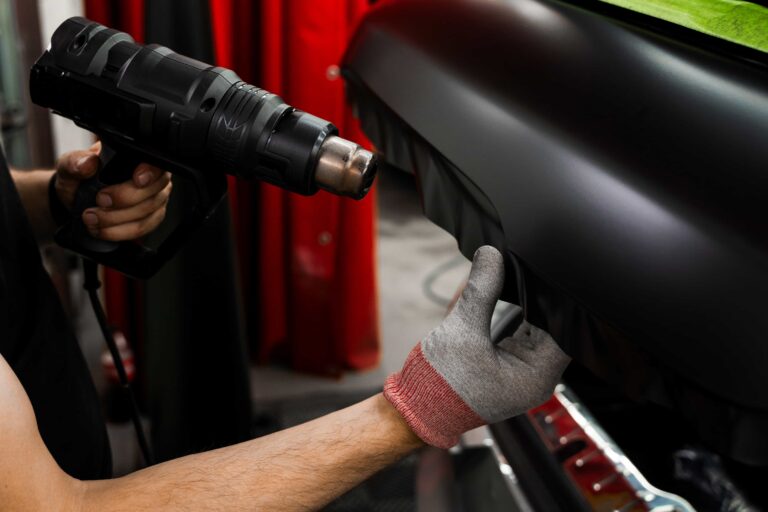
The physical installation of architectural graphics requires a deep understanding of surface physics. Professional installers use digital heat tools to post-heat the vinyl.
This warms the film to its exact material glass transition temperature, resetting its structural memory. This locks the vinyl into its final shape, preventing it from lifting out of deep channels or rivets when summer temperatures spike.
Quick Answer: Maximize the lifespan of your outdoor graphics by gently washing them every few months with a microfiber cloth and biodegradable soap, while strictly avoiding pressure washers.
Even the most resilient exterior vinyl signs benefit from proactive care. Airborne soot, agricultural dust, and industrial emissions collect on sign surfaces. When baked by solar heat, this grime forms an acidic layer that breaks down protective UV laminates.
✅ Quick Tip: To preserve your investment, establish a quarterly cleaning schedule using only pH-neutral soaps.
Regular Gentle Rinsing: Use a clean sponge or a soft microfiber cloth with mild soap.
Avoid High-Pressure Washing: Never use a commercial pressure washer close to the edges. High pressure cuts through edge sealers, forcing water beneath the film.
Keep Harsh Chemicals Away: Do not use solvent-based cleaners, citrus degreasers, or abrasive tools.
Quick Answer: True brand authority requires matching your high-quality outdoor signage with custom apparel and vehicle wraps to create a cohesive, professional local presence.
Your outdoor signage is a core part of your public identity, but it shouldn’t stand alone. When a customer sees your durable storefront display, that same visual quality should carry over to your mobile assets.
Your fleet graphics should act as a seamless extension of your building’s signage. When a service truck pulls into a driveway, the design layouts should perfectly mirror your storefront.
For mobile service businesses across Marion County, matching your outdoor signs with custom apparel builds immediate trust. Using the same clean logos across both your signage and your team’s uniform shows customers that your business is established and dependable.
High-quality exterior vinyl signs made from cast vinyl and coated with a UV-protective over-laminate will typically last 7 to 10 years in Florida. Cheaper calendered vinyl signs usually fade, crack, or peel within 2 to 5 years due to the intense sun and heat.
No, you should never pressure wash outdoor vinyl signs. The extreme water pressure can easily break the edge seal of the laminate and force water underneath the adhesive, causing the graphic to lift and fail prematurely.
Bubbling is usually caused by improper surface preparation or the use of cheap calendered vinyl that cannot handle thermal expansion. When the sun heats the sign, trapped outgassing from the substrate or poorly applied adhesives expand, creating visible bubbles.
Cast vinyl is poured as a liquid, giving it zero structural memory so it won’t shrink in the sun, making it ideal for permanent outdoor signs. Calendered vinyl is stretched through rollers, meaning it will eventually shrink and crack when exposed to high heat.
Yes, UV over-laminate is absolutely essential for exterior vinyl signs. It acts as an industrial sunscreen, blocking the ultraviolet photons that cause molecular breakdown and color fading in your printed graphics.
Investing in your business’s visual presence builds long-term local trust. While DIY methods may save upfront costs, the harsh Florida climate quickly exposes shortcuts, resulting in peeling materials and a diminished brand image.
To ensure your exterior vinyl signs outlast the heat, remember these core steps:
Insist on premium cast vinyl with a UV-protective over-laminate.
Ensure surfaces are chemically prepped to prevent adhesive failure.
Utilize professional installers who utilize post-heat calibration.
Maintain your signs with gentle, pH-neutral hand washing.
By working with an experienced visual partner, you avoid wasted ad spend and ensure your displays stand up to the toughest summer weather.
Ready to elevate your brand’s look? Explore more Brick City Branding guides or reach out today to set up a comprehensive design consultation. Let’s build a durable, high-impact visual presence that supports your business growth for years to come.
Connect@brickcitybranding.com
352 - 820 - 5771
© 2026 Derrick Ventures LLC, DBA Brick City Branding. All rights reserved.