Durability Winner: Laser engraving alters the base substrate or removes powder coatings permanently, rendering it 100% scratch-proof and entirely dishwasher-safe.
Aesthetic Winner: Screen printing reproduces vibrant, multi-colored designs with precise Pantone (PMS) matching, whereas engraving remains monochromatic.
Financial Breakeven: Screen printing carries high upfront tooling fees per color, making it optimal for massive bulk runs. Laser engraving runs digitally with minimal setup, making it highly cost-effective for small-to-medium runs.
Long-Term ROI: Laser-engraved drinkware delivers a 20x longer operational lifecycle, dropping your long-term Cost Per Impression (CPI) significantly compared to flaking screen-printed alternatives.
1. Introduction: The Stakes of Corporate Merchandising
2. Deconstructing Laser Engraving vs Screen Printing Drinkware
3. The Science of Longevity: Durability Under Fire
4. Visual Aesthetics and Design Constraints
5. The Trap of DIY Customization: Protecting Your Corporate Reputation
6. Financial Analysis: Calculating Your True Marketing ROI
7. Direct Feature Comparison Matrix
8. Strategic Recommendations: Which Method Fits Your Brand?
9. Conclusion: Invest in Value, Not Just Visibility
10. Frequently Asked Questions
When selecting corporate merchandise, the items you distribute act as a physical extension of your brand equity. A premium, well-crafted item implies a premium, reliable service. Conversely, a flawed or deteriorating product sub-consciously signals cut corners and poor quality control to your clients. Among the most popular and high-utility promotional items globally is custom drinkware, travel mugs, insulated tumblers, water bottles, and glassware.
When analyzing laser engraving vs screen printing drinkware, laser engraving offers permanent, dishwasher-safe durability for long-term ROI, while screen printing provides vibrant, multi-color branding at lower costs for short-term bulk events. Choosing the wrong method can cause your corporate logo to flake, bubble, and peel within months.
Every time an employee brings a branded tumbler into a high-stakes board meeting, or a client uses a promotional water bottle at a public gym, your logo is on display. If that logo is crisp, tactile, and pristine, it reinforces corporate professionalism. If it is chipped, peeling, or faded, it actively degrades your brand reputation. This comprehensive guide applies decades of manufacturing and print-industry experience to dissect these two primary customization frameworks as of 2026. We will look past the surface aesthetics to evaluate material science, lifecycle mechanics, and real-world marketing ROI.
⚡ Quick Answer
Laser engraving is a digital, subtractive method that physically etches designs into material substrates using thermal energy. Screen printing is an analog, additive process that transfers liquid inks onto surfaces through mesh stencils.
Laser engraving is a subtractive manufacturing process. It does not introduce external colorants, inks, or chemicals to the surface of the item. Instead, a highly concentrated, computer-guided laser beam, typically a fiber or CO2 laser system, interacts directly with the material substrate.
When applied to powder-coated stainless steel drinkware, the high-energy thermal beam vaporizes the external layer of paint or coating. This cleanly exposes the raw, durable stainless steel beneath. When applied to bare metal or glass, the laser physically etches or micro-fractures the surface structure, creating a permanent, tactile, frosted, or high-contrast mark.
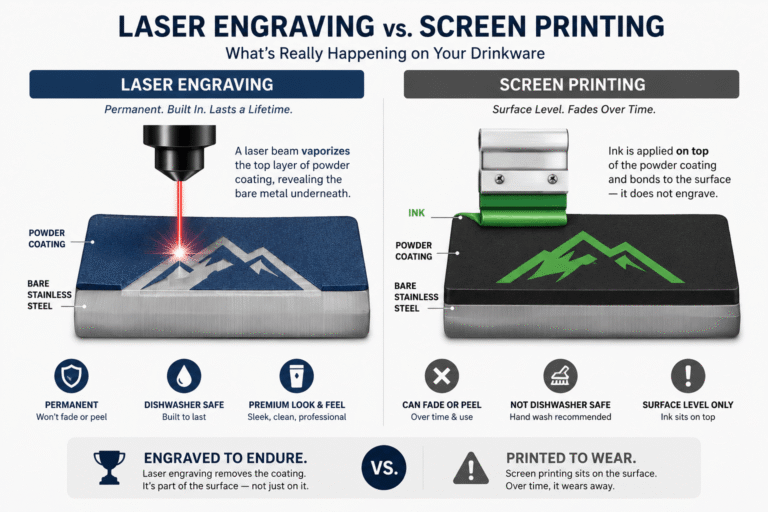
Screen printing, or silkscreening, is an additive production method with roots tracing back centuries, though modernized with automated presses and ultraviolet (UV) curing units. The process requires a mesh screen stencil for each individual color in the design.
Inks, often heavy-bodied plastisol, solvent-based, or UV-curable formulations, are forced through the unblocked sections of the mesh using a synthetic squeegee blade directly onto the curved surface of the drinkware. Once applied, the substrate passes through a curing oven or under a high-intensity UV light matrix to cross-link the polymers. This bonds the ink layer to the outermost surface of the product.
📊 Data Point: According to industry specifications published by the w3.org Semantic Web standards and commercial print groups, modern automated rotary screen printing systems average an ink film thickness of 20 to 50 microns depending on polymer curing parameters.
⚡ Quick Answer
Laser-engraved markings feature permanent abrasion resistance and are completely dishwasher safe. Screen-printed inks sit on top of substrates, leaving them vulnerable to chipping from mechanical friction and thermal dishwasher stress.
Because laser engraving alters the physical geometry of the substrate or permanently removes surface coatings, it features absolute resistance to abrasion. It cannot be scraped off with a fingernail, keyed off by loose items in a backpack, or worn away by persistent hand sweat and oils. The logo remains as long as the structural integrity of the tumbler itself stands.
Screen printing, on the other hand, relies entirely on surface adhesion. No matter how advanced the ink chemistry or how thorough the pre-treatment process (such as flame or plasma treatment for plastics), the ink remains a microscopic film sitting on top of the drinkware. Over months of routine handling, mechanical friction from cup holders, keys, and desk drops will break down this bond. This leads to scratching, chipping, and a progressively degraded aesthetic.
💡 Expert Insight: In commercial hardware manufacturing, laser marks are categorized under absolute structural modifications. Unlike coatings, they cannot be quantified by traditional cross-hatch tape adhesion tests because the marking is part of the substrate itself.
The modern consumer demands dishwasher-safe convenience. This is where screen printing frequently fails over a medium-term horizon. Dishwashers subject drinkware to a harsh mix of high-temperature water cycles often exceeding 60°C (140°F), aggressive, highly alkaline chemical detergents, and rapid thermal expansion and contraction cooling phases.
During these cycles, the thermal expansion rate of the underlying steel or plastic differs from the expansion rate of the cured screen-printed ink film. This creates structural micro-fissures in the ink. Combined with chemical attack from detergents, water penetrates beneath the ink layer, causing it to flake, bubble, and peel off in large sections.
Laser engraving experiences none of these vulnerabilities. Since there is no secondary material layer to separate, laser-engraved items are completely, unconditionally dishwasher-safe. The underlying steel cannot peel or fade from heat or chemical wash cycles.
⚡ Quick Answer
Screen printing allows for full-color, precise Pantone matching ideal for vibrant brand palettes. Laser engraving is restricted to monochromatic tones determined by the color of the underlying metal or glass substrate.
If your corporate identity relies strictly on specific, multi-colored brand assets, such as a vibrant primary logo featuring gradients or distinct color combinations, screen printing is uniquely capable of rendering those exact hues. Specialized ink kitchens can mix liquids to match exact Pantone Matching System (PMS) color values, laying down rich, opaque layers that pop vividly against dark or light drinkware backdrops.
⚠️ Common Mistake: Forgetting that laser engraving is fundamentally monochromatic can ruin a design plan. You cannot choose the color of a laser engraving. The resulting color is entirely dictated by what material rests beneath the surface coating.
On a black powder-coated flask, the engraving will show as bright stainless steel. On clear glassware, it will appear as a frosted white matte etching. For brands aiming for a subtle, high-end, executive aesthetic, this limitation is often seen as an advantage. It delivers a sleek, minimalist look that exudes luxury.
Modern galvo-driven fiber laser markers operate at exceptional resolutions. They effortlessly render ultra-crisp geometric patterns, micro-text, and intricate vector wireframes that screen printing screens simply cannot resolve. Screen printing inks can bleed slightly across the mesh boundaries, meaning ultra-fine details or tiny text characters can occasionally muddy or bridge during long production runs.
✅ Quick Tip: To ensure your digital vectors are optimized for high-fidelity production before submitting them to our print team, review our comprehensive internal artwork vector conversion and pre-flight design guide to eliminate line-bridging artifacts.
⚡ Quick Answer
Bypassing industrial manufacturing in favor of desktop or hobbyist engraving equipment leads to distorted proportions and high asset waste. Professional production secures consistent quality and safety compliance.
In an effort to lower upfront costs, some small enterprises consider managing their custom drinkware production in-house. This often involves using hobbyist desktop vinyl cutters, craft stencils, or entry-level open-frame diode lasers. Avoiding professional industrial production is one of the most high-risk choices a brand manager can make. Corporate gifting requires absolute consistency across hundreds or thousands of identical units.
Hobbyist equipment lacks the advanced rotational axes, focal sensors, and power calibration profiles necessary to handle curved, tapered surfaces properly. The results of DIY production speak for themselves:
Distorted Proportions: Logos appear warped, stretched, or egg-shaped as the machine struggles with the complex radius of a drinkware container.
Improper Adhesion and Burning: Desktop craft setups lack precise thermal monitoring, leading to either under-cured ink that wipes off immediately, or scorched powder coatings that release toxic fumes and leave charred edges.
High Attrition Rates: Spoiling 15% to 20% of your blank product inventory due to alignment errors instantly erases any perceived savings from bypassing a commercial production house.
Partnering with an established manufacturing provider ensures strict compliance with product safety standards, automated structural quality checks, and repeatable precision across every single batch.
⚡ Quick Answer
Screen printing features high initial screen setup charges but lower per-unit costs at scale. Laser engraving features negligible setup fees and a substantially lower lifetime Cost Per Impression (CPI) due to its multi-year lifespan.
Screen printing comes with significant upfront preparation costs. Every color in your corporate logo requires a separate physical screen, photographic exposure process, press setup, and post-production cleaning cycle. If you have a three-color logo, you will pay three distinct setup fees before a single drop of ink touches a cup. This makes screen printing financially inefficient for smaller, customized corporate runs.
Laser engraving runs entirely on digital pathways. The vector file is imported directly into the control software, requiring no physical screens, plates, or chemical film setups. Consequently, setup costs are minimal to non-existent, making it highly affordable for low-to-medium volume orders, while scaling down in unit price for mass distributions.
Let us look at a realistic corporate procurement case study:
Scenario A (Screen Printed Tumbler): You purchase 500 screen-printed insulated mugs at $6.00 per unit. The total investment is $3,000. The item looks great on day one, but after three months of routine use and dishwasher cycles, the logo chips and peels. The recipient, embarrassed to carry a damaged item into client meetings, throws it away. The active marketing lifespan of that product was roughly 90 days.
Scenario B (Laser Engraved Tumbler): You purchase 500 laser-engraved insulated mugs at $7.50 per unit. The total investment is $3,750. The initial cost is 25% higher. However, because the mark is permanently etched into the steel, the tumbler remains pristine after 5 years of daily use. It continues to display your company’s logo on office desks, flights, and conferences for 1,825 days.
By choosing laser engraving vs screen printing drinkware, you pay a slightly higher upfront fee to secure a product lifespan that is twenty times longer. The long-term marketing value and continuous brand exposure make laser engraving the clearly superior financial investment for building sustained brand equity.
| Feature / Criteria | Laser Engraving | Screen Printing |
| Primary Benefit | Unmatched permanence and luxury feel. | Vibrant, exact multi-color reproduction. |
| Durability Level | 100% permanent; scratch & chip-proof. | Moderate; prone to scratch & flake over time. |
| Dishwasher Safe? | Yes, fully dishwasher safe indefinitely. | No, typically restricted to hand-wash only. |
| Setup Cost Profile | Very low; fully digital software configuration. | High; requires physical screen setup per color. |
| Optimal Order Volume | Excellent for small, medium, and massive runs. | Ideal for high-volume, cost-conscious bulk runs. |
| Texture Experience | Elegantly recessed into the outer material. | Slightly raised profile on top of substrate. |
| Material Flexibility | Exceptional on metals, glass, and wood. | Excellent on plastics, metals, and ceramics. |
You are ordering premium stainless steel travel mugs, double-walled tumblers, or luxury glassware.
The items are intended as high-value executive gifts, employee onboarding packages, or premium client appreciation rewards.
You require absolute assurance that the items will look flawless after years of heavy daily use and dishwasher cleanings.
Your brand identity embraces a sleek, sophisticated, minimalist, or modern visual style.
You are running agile, low-to-medium volume production batches where high print screen setups are cost-prohibitive.
Your brand identity relies on bright, non-negotiable multi-colored logos that require precise Pantone color validation.
You are ordering high-volume, budget-conscious promotional items for mass distribution at large trade shows or public festivals.
The base items are made of affordable plastics or lightweight materials better suited for ink applications than high-energy thermal laser work.
The intended campaign lifespan is short-term or event-specific, where multi-year product durability is not a primary KPI.
In the debate between laser engraving vs screen printing drinkware, there is no generic, one-size-fits-all answer. However, when evaluating long-term corporate value, structural durability, and brand protection, laser engraving remains the gold standard for professional applications.
By physically etching your identity directly into high-quality materials, you ensure that your initial marketing spend continues to yield impressions, protect reputations, and build customer trust for years to come. When planning your next campaign, evaluate the lifetime lifespan of your custom assets. Do not let a peeling, chipped logo undermine your organization’s hard-earned professionalism.
Laser engraving is substantially more durable because it physically etches the substrate or removes outer coatings down to the raw metal. Screen printing applies a surface film of ink that can scratch, flake, or peel over time due to mechanical friction.
Screen printing is highly recommended for multi-colored logos because it applies distinct ink layers mixed to exact Pantone values. Laser engraving is a monochromatic process that only reveals the natural color of the underlying material substrate.
Yes, laser engraved drinkware is completely dishwasher safe because there are no ink films or adhesive layers to break down under high heat or alkaline chemicals. The etched mark remains permanent for the lifetime of the product.
Laser engraving utilizes entirely digital files sent straight to control software without physical preparation steps. Screen printing requires manufacturing a custom structural mesh stencil screen for every individual color in your logo, driving up initial setup engineering fees.
Because laser engraving bypasses physical screen fabrication and ink drying or curing processes, it generally yields a much faster production turnaround time for small-to-medium runs compared to multi-stage multi-color screen printing.
Laser engraving delivers a dramatically superior CPI over an extended horizon. While it carries a slightly higher upfront manufacturing cost per unit, its multi-year structural lifespan ensures your brand continues to win high-quality impressions long after printed ink flakes off.
Connect@brickcitybranding.com
352 - 820 - 5771
© 2026 Derrick Ventures LLC, DBA Brick City Branding. All rights reserved.